
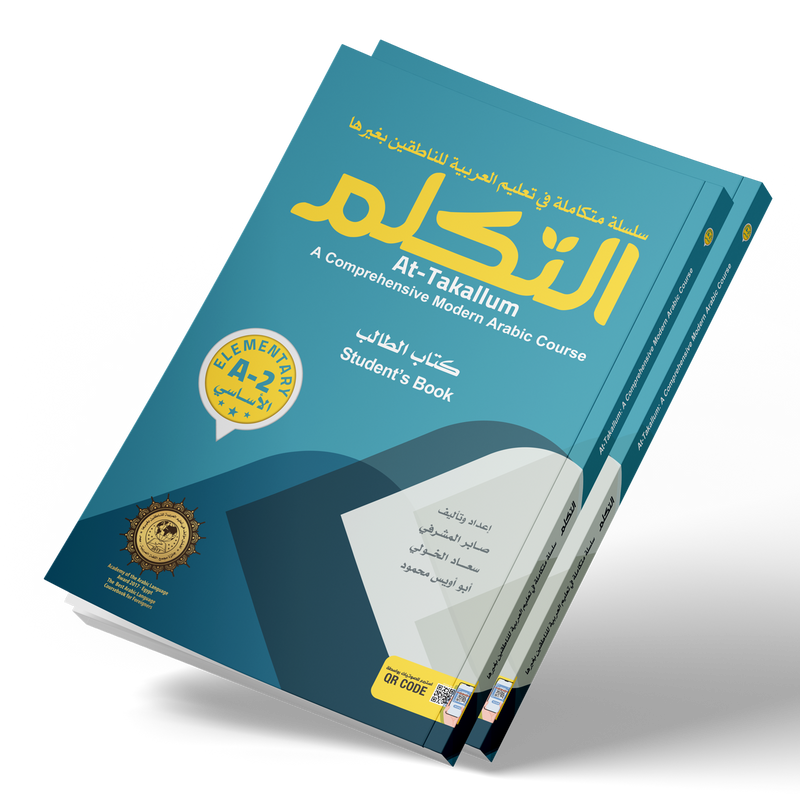
AT-TaKallum Elementary A2 (SB + WB)-QR CODE
About This Book
This book is the second stage of the beginner level of At-Takallum. It contains an introduction and eight units. The Teacher's Guide on the series website explains the book's objectives, how to teach its content, the time needed for each lesson, plus teaching aids, supplementary materials, and the Arabic and foreign series and references we drew on.
1. Introduction: 13 illustrated instructions for the most common commands learners meet in almost every unit, plus a review of key vocabulary from the starter book.
2. Units: eight units, each made up of two parts.
Part one: vocabulary, dialogue or presentation, grammar, listening and comprehension, sounds, conversation.
Part two: vocabulary, dialogue, grammar, reading and comprehension, linking (fluent reading), writing.
Vocabulary: 50 to 70 words across the two parts. The Student's Book includes a few exercises on using them; most of the practice is in the Workbook.
Dialogue or presentation: natural situations that use the lesson's vocabulary in dialogue or short reading texts, showing how the words are used in everyday life.
Grammar: the content is based on two main criteria – the most common and widely used grammar topics in Arabic, and an analysis of learners' grammatical and morphological errors.
Language skills: the four core skills are spread across each unit, two per part: listening and speaking in part one, reading and writing in part two.
Listening: helps learners recognize the vocabulary studied and how it is used in different structures, understand it within narrative or dialogue texts, and grasp new words from context.
Speaking: builds learners' motivation and aims to give them control of the new structures and expressions, use them effectively, and manage a discussion on the unit's topic.
Reading and comprehension: carefully chosen texts are preceded by warm-up questions and pictures and followed by comprehension and true/false questions. Reading aloud is used to improve pronunciation, intonation and applying grammar.
Writing: one of the hardest skills at early levels, so it comes last. It includes:
- Functional writing: filling in personal details, phone numbers and similar information.
- Creative writing: guided writing on the unit's topic following set steps, using linking words correctly.
- Dictation: practised indirectly through answering questions, filling gaps and writing unit vocabulary correctly; the Workbook covers it directly.
- Calligraphy: beautiful Naskh models from the Qur'an and Hadith linked to the unit's topic, to help learners master Naskh script.
Sounds: exercises to distinguish letters with similar pronunciation, by listening and speaking, using samples from the first dialogue and fun drills.
Linking: strengthens reading skills and speed and solves many reading difficulties using samples from the reading text itself.
| Pages | 318 |
|---|---|
| Dimensions | 21*29.5 |
Reviews coming soon. Share your feedback